The G-spot of Europe - August 24, 2023
- Scott Farnsworth
- Aug 23, 2023
- 6 min read
Updated: Aug 27, 2023
SUMMARY Started the day with a beautiful brunch in the main dining room with an amazing selection of everything! We arrived in Klaipeda, Lithuania. Scott and I split up, temporarily, for different shore excursions. He toured an nuclear missile silo from Soviet Union days and I visited the beach resort of Palanga, seeing the botanical garden and Tiskeviviai Palace which houses the Amber Museum, and strolled the pedestrian promenade in the city center. - Karen
DETAIL
Well you gain some, and you lose some. Today we gain another country on our list of places we’ve visited: Lithuania. And we lose an hour. We’re sure we’ll get that hour back before long.
We’re currently in the middle of the Baltic Sea. This means no internet for me (from my cell phone) and Karen, who pays for the ship’s wifi, has very spotty coverage. We don’t get into port until the afternoon, which means no decent internet until later.
A late day arrival means a Jazz Brunch in the main dining room, with the food stations manned by the ship’s officers. I can’t decide if this is a fun, different part of their job, or if they’re thinking “I went to maritime school to be putting croissants on these people’s plates!” They seem smily enough. There’s champagne and/or mimosas on the way in and the Baltic is glassy smooth so carrying food to your table is not a problem.
After brunch, and a slow glide down a long channel, we do get to port. The captain (or one of his underlings) does a 180 and the ship is slowly nudged up against the dock. At excursion time Karen and I head in opposite directions. She’s going to some museum and an amber factory/store (details further down) and I’ll be checking out a soviet nuclear missile silo.
My guide is Antanas, a spry, mid-30’s college professor of psychology. Upon getting on the bus, he says (in his best Russian accent) “Western Capitalists, welcome to Lithuania, you’ll forget it in an hour”. We get jokingly called “Western Capitalists!” in his Russian accent throughout the day. It’s always funny.
Antanas’ English is impeccable and he has lots to say. He’s funny, relating to us a joke from the Vilnius (capital of Lithuania) tourist board. The joke made the rounds, you might have heard it on Jimmy Kimmel or another late night show. The tourist board slogan? “Vilnius: the G-spot of Europe… no one can find it but it’s amazing when you do”.
We’re not in Vilnius but rather in Klaipeda, the third largest city of Lithuania. The city name sounds to me a bit like an STD.
Antanas relates to us the history of Lithuania and the surrounding countries. This gives him many opportunities to express his intense dislike of current and former leaders of Russia, Belarus, the former Soviet Union, and the like. We see lots of soviet era apartment building which look as ugly as they do uncomfortable.
In the 1500s, Lithuania joined with Poland under a single king and for a time were the largest country in Europe. That was a proud time for them. After that, the Soviet Union took them over. They got their freedom in 1918, independence! Only to be occupied three times, in World War II, until 1990 when the USSR fell. In 2004 Lithuania joined NATO and the EU. They seem like a very proud people who are happy to be free and don’t take it for granted. They maintain their cities, roads, homes, possessions, etc. very well.
David somebody-or-other lived 18 miles from here and designed the Star of David. (Really?) The country is mostly flat with the highest point being 1,000 feet above sea-level, near Vilnius. They grow lots of produce and grain and do a lot of export. They have a Bison-like animal which is the national animal and the Stork is the national bird. Normally by now the storks would have all started flying south for the winter but we did see eight or ten still here.
Net average pay is 900 to 1,100€ per month. Gas prices are similar to California. That math doesn’t seem to work out. Their language is among the top five hardest to learn, but thankfully the kids are taught English from a very early age. The biggest group of Lithuanians abroad are in Chicago.
At the missile site, where there are four silos, Antanas puts on a military costume of sorts, from the guest office of the facility. It’s a Russian Amy coat and a navy cap. A bit incongruous. The silos were built in two years, from 1960 through 1962 and the facility was in operation from ’63 through ’78 when the equipment deemed way too far out of date.
The site housed four Russian SS4 missiles each of which deliver two megatons of explosive. This makes them each 140 times the size of the bombs dropped on either Hiroshima or Nagasaki. In twenty minutes a missile could be ready to launch and then 12 minutes later it could arrive in any city the distance of Madrid or closer. When missiles were shipped to Cuba back in the day some of them came from here. These missiles were the closest to “the west” that Russia had. We knew the missiles were here starting in 1963, but the Russians never knew we knew.
We get to go under the 240 ton cover protecting each silo and see all of the rooms that managed the missiles and their launching. Thankfully no missiles were ever fired (not even test firings). The electronics, from the 1960s, are comically old looking. It is very chilling to peer down into the missile silo. There are three places in the world where you can do this (as a civilian). Here, in Kiev, Ukraine, and in Tucson, Arizona.
In 1990, after the Soviet Union fell, the locals found out what was going on here. Before that they just knew it was a military site. The Russians just left it so locals, who had little to nothing, came in and cut up a lot of the metal to sell as scrap. Sadly some of the chemicals around the metal took its toll on the scavenger’s health.
After emerging back into the open air we drive to a nice restaurant to try some traditional Lithuanian food and beer. It was good and fun.
From Karen: We were were driven from Klaipeda to Palanga, a very popular beach resort on the Baltic. There we toured the Tiskeviviai Palace with a beautiful botanical garden and mansion which houses the Amber Museum. We saw some spectacular amber pieces and learned way more about amber than I ever wanted to. Afterwards, we walked the central promenade with bars, restaurants and stands selling, what else, amber! We heard a lot about the awful things that happened while Lithuania was part of the Soviet Union. They are very glad to be out of that situation, needless to say.
Back on the ship Karen and I link back up We have dinner in the main dining room with Gwen and Fred, a delightful couple we met over a jigsaw puzzle earlier in the cruise. They’re from Las Vegas, another US warm spot.
At 9 pm Karen and I both go to the main entertainment venue, the Cabaret Lounge, to hear the Pursuit dancers and singers perform “Imagine” music of the late 1960’s. They played ‘Me and Bobby Maggie’, ‘Imagine’, ‘Fire and and Rain’, ‘R-E-S-P-E-C-T’, music of Credence Clear Water Revival, and others it was great fun, as always, but then it’s time for bed. Tomorrow is Gdanśk (and we get our missing hour back).
Photos
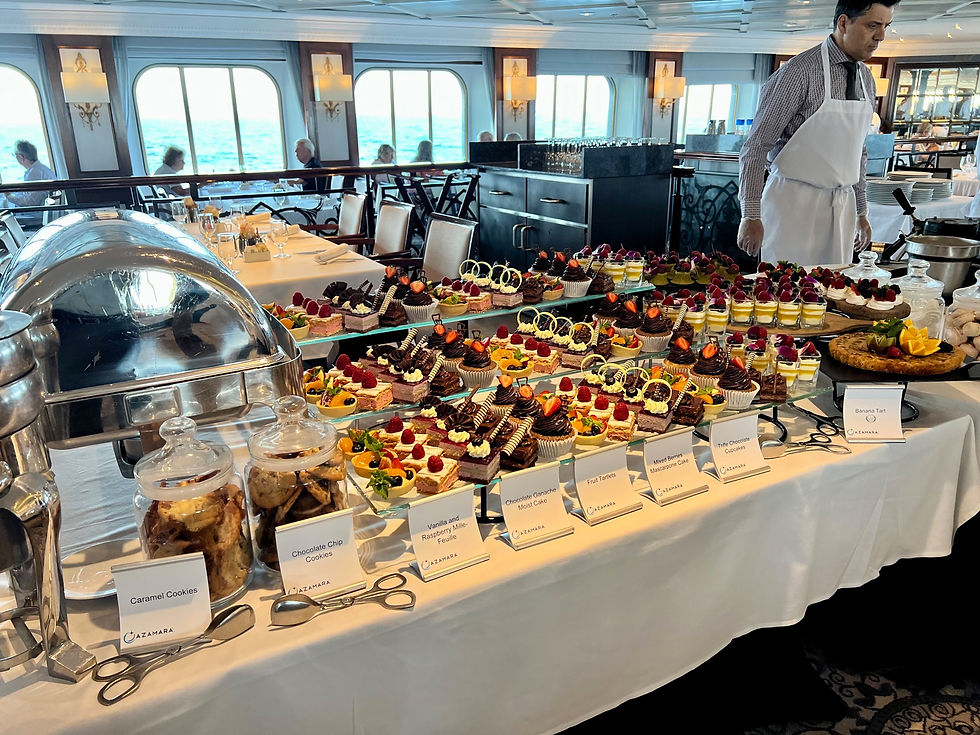
Just one of many tables laden with food for a delightful brunch on some of the days we get into port later

The Botanical Garden and Tiskeviviai Palace in Palanga

The afore mentioned palace, which is also home to the Amber Museum

An amber flask (approximately 8" tall)

Pedestrian promenade in Palanga

Good Comrade Antanas in costume in front of a hardened nuclear missile silo

The entrance to the missile silo was through a thick metal door, then another, then another...

A model to show us what was where in the silo

Dummies showing us what the 'listeners' looked like who listened for the "Launch the missiles!" message. To not miss any messages their headphones had 50' of wire so that they could listen no matter what they were doing.

The silo. Shudder.

Tasty snacks after the nuclear missile silo.

By our restaurant they had authentic Lithuanian building models to play on

We did get to see the lucky storks. Bright white with deep black and then ends of their wings. Striking.

The music of the late 1960's, complete with costumes.


Comments