Pooping on your joey?? - April 10, 2025
- Scott Farnsworth
- Apr 9, 2025
- 8 min read
Updated: Apr 14, 2025
SUMMARY Full day on an organized tour starting with a drive through a beautiful valley along the Derwent river passing berry and hops farms. Stopped for a “bush walk” at Mount Field National Park which took us through very tall eucalyptus trees and past a couple of beautiful waterfalls. Saw our first paddymelons including a joey. Visited the Bonorong Wildlife Sanctuary, a very feel good rehabilitation place for injured animals including kangaroos, Tasmanian devils, a wombat, and lots of birds. Lunch in a beer garden in Richmond, a picturesque town with lots of heritage protected building façades. Scallop pie to share from the bakery. End the trip with a drive up Mount Wellington, also known as Kunanyi. Fabulous view, but EXTREMELY windy and chilly. - Karen
DETAIL Again, we’re up before sunrise. Fall post-daylight savings time will do that. It does let us see a pretty sunrise, giving us hope for another sunny day. Not unlike our Sydney day at the animal park, today we’re taking a long drive to visit regional marsupials.
By 7:30, we’re outside a nearby hotel, awaiting our ride. We duck inside for a quick flat white while we still have time. Tricia tells us the fancy coffee maker at our hotel is on the fritz—yikes. Brett, our driver, picks us up a bit late, but that’s fine. There are already other people on the bus, and we’ll make one more pickup stop.
We drive up and up toward Mount Field, a local rainforest. Along the way, we pass where we walked yesterday. Brett lives nearby and tells us of the many platypuses in that waterway. We’re sorry we didn’t see them. Our driver is maybe late middle age. He’s from Sydney and moved down here with his family three years ago. Reportedly, most people move in the opposite direction—from the country to the big city—for better jobs. Here in Hobart there are only about 200,000 people, we’re told, a far cry from Sydney’s six million. It does seem a bit more relaxed here. For sure, the outfits are less she-she and more tattered flannel.
We hear about our primary destination today, the Bonorong Animal Rescue Center—or something like that. Brett ran a zoo in Sydney and later managed the animal rescue and rehabilitation arm of Bonorong for a while. He has solid credentials for informing us about marsupial husbandry.
As we drive out of Hobart, things are pointed out and we’re told about fun bars and cafés we might visit: “Room for a Pony” and “Everyman and His Dog.” Fun names. We’re told to try the scallop pie (the shellfish, not the shape) and the lavender ice cream (“It’s not overly powerful”). I’m not sold. At the Salamanca Saturday Market, we’re supposed to try the wallaby burrito.
The stories of Tasmania and Australia always seem to start a long time ago, when the Earth’s landmasses were one connected blob. Eventually, Australia, Hobart, and Antarctica floated south to where they are now. Animals here evolved on their own into fairly weird pouched, duck-billed egg-layers with big feet (not all at once). The big-footedness of kangaroos, wallabies, and the like gives rise to their “macropod” designation.
We lament not having gotten to the MONA museum yesterday and hear more about it. There’s one single male curator—eccentric, with lots of money. He likes to be “aggressively confrontational” in his art. The ads for the MONA? He promotes his worst Yelp reviews: “I hated the place” and “Disgusting!” One exhibit was titled “Women Only,” and men were kept out. Scantily clad muscular male waiters wandered around with trays of champagne. There was a sex discrimination lawsuit that the MONA lost, then won in the Supreme Court.
We’re driving alongside the Derwent River and it’s beautiful. There are lots of hops farms around. We hear about the arrival of the convicts and remember we need to look up the two Farnsworth convicts listed on our hotel welcome letter. How close are those prisoner relations?
The story of how the land—and lives—were taken from the Aboriginal people is always hard to hear. How they went from 15,000 people living here for 50,000 years down to 300 in twenty years, and later to 47—transported to an inhospitable island to try to survive. The descendants of the settlers feel bad and are trying to make up for their ancestors’ horrific treatment, but it’s hard.
We learn something likely never to be useful: how to breed a wombat. They’re pig-sized balls of solid muscle with a 1.5” bone plate under their back fur to withstand abuse from their mates—or to crush predators to death against the walls of their burrow. In a 30-day period, a female is fertile for just 12 hours. That the wombat sleeps 18 hours a day does not make for good math. Solution? Kick your mate in the head, repeatedly, at the critical time. The male wakes up, pissed, bites and abuses the female, and eventually they have sex. Such a mating ritual!
As we reach the rainforest, Brett apologizes for the “heat wave today.” It’s unusual—it’s 59° out now. He turns on the bus’s air-con.
Having learned how wombats get pregnant, it’s time to learn how their young are raised. We all know kangaroos have pouches. So do koalas, wombats, and Tasmanian devils—but their pouches are upside down, facing downward. It’s muscle that keeps the young from falling out. The female licks a path from the birthing orifice to the pouch to indicate the route for the baby to follow to its new home.
The baby suckles milk in there, but the young (all called joeys) don’t know what food they should eventually eat, nor do they have the gut flora to digest it. No worries. When the joey sticks its head out of the pouch—upside down—it’s very close to mum’s anus, and poop gets on the kid’s head. Yum! A bit of snacking, and those problems are solved. Is nature creative (and gross) or what?
At Mount Field we hop off the bus and are immediately told there are a number of pademelons (or just “paddies”) in the nearby bush—mums and their joeys. We peek under the foliage and sure enough, there they are, peeking out with their beady eyes.
The hour-long primordial walk through towering ancient eucalyptus, bright green moss, and monstrous fern trees is unworldly. We’re constantly hearing the squawks of kookaburras and cockatoos off in the distance. They sound eerily like pterodactyls—but they’re extinct (aren’t they??).
The waterfalls are beautiful, and the hike (all downhill) is refreshing. We’d heard about the fight between those who make their living cutting down old-growth eucalyptus (for wood pulp and construction material) and those who think maybe we should preserve them. The government’s solution? If anyone identifies a tree of at least certain dimensions, the government agrees to preserve it and the area around it.
We hear about salmon farming, where the seals like to come and have a good meal. The solution? Explosives to scare the seals off. Ugh. At one point, a bad storm ripped open one of the salmon farming nets and 60,000 salmon were freed. The solution? A call to the locals: Please go fishing!
We hear about Brett’s experiences managing the 24/7 animal rescue part of Bonorong. Marsupials getting hit by cars is sadly common in these parts. When that happens, you’re supposed to drag the carcass off to the side (so subsequent scavengers don’t also get hit) and do a “pouch check” (for a joey). If there is one, you don’t remove it—the baby is OK in the pouch of its dead mum for up to three days. Instead, you bring the dead animal to a rescue facility for raising. One thing Brett had to become good at was blending up a good eucalyptus-poo shake for little joeys. (Dad! Not in the kitchen!!)
We have lunch in Richmond, at the oldest surviving convict-built pub in Australia (just down from the oldest surviving convict-built bridge and the oldest surviving convict-built Catholic church). We get and sample the scallop curry pie. It’s fine.
We learn that half the people in Tasmania—the poorest state in Australia—can only read to an 8th-grade level, which is considered illiterate. They oppose all proposals from the big-city state government in Hobart, which they call “Nobart.”
We hear about bushrangers—outlaws who robbed people—and the “Gentleman Bushranger,” who didn’t like to rough people up, so he got them blinding drunk so he could rob them.
Bonorong is great fun. The animals there are only kept until they can be rehabilitated and released—that is, if they’re native. If they’re non-native, they would either be euthanized or (as normally happens) allowed to live out their lives here. Some animals have defects or injuries that will never heal enough to allow them to survive in the wild, so they’re here for life, too. We’re allowed to feed and give belly and shoulder rubs to the kangaroos. To cool off, they lick their forearms—the evaporation lowers their body temperature.
After the rescue center, we drive to the top of Mount Wellington. It’s super windy up there, but we snap pictures and climb to the top of the oh-so-windy pinnacle. The view is tremendous. On the drive back down, we stop at a natural spring to refill our water bottles. More driving and more nature lessons. Yes, they have the 3-4’ wingspan flying fox fruit bats, but they also have microbats the size of a moth. You’re lucky I didn’t include all of what we learned today—this post would’ve been really long.
We have pizza dinner at In The Hanging Garden. Their slogan is something like “No one sleeps,” but that’s just at the height of summer/tourist season. No one sleeps, and the place was essentially closed by the time we took our last bite.
Back at our hotel, we ask the gentleman behind the bar if it’s possible to see the Southern Cross. He says absolutely and charges out with us toward the entrance. The bartender lady is in the lobby at the same time, so she comes charging out too. We all look up at the sky and learn how to identify the Southern Cross! We’re now one step closer to being able to navigate in these parts.
Photos
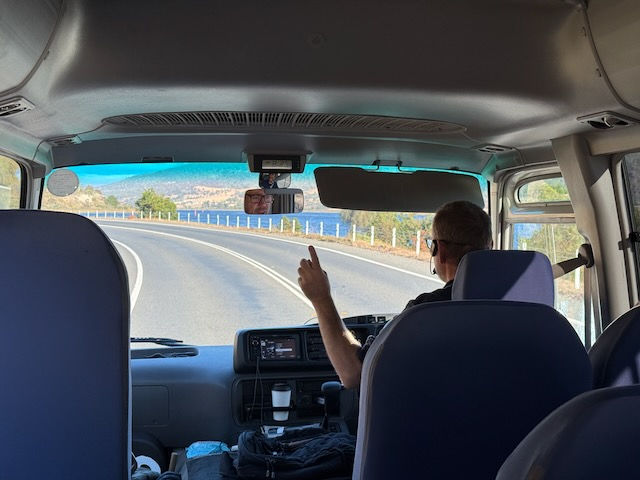
Our only picture of awesome tour guide Brett. He was a fountain of information, especially on marsupial animal husbandry.

We were driving down the Derwent Valley, next to the Derwent River. We passed many farms growing hops. We looked over and sure enough, Don's ears were perked up.

Stepping off the bus Brent says "peek back into the bush and you'll see a Paddymelon ("Paddy") and her joey. The beady eyes give them away.

We're in the Mount Field National Park, on the Tall Trees Trail. These are old growth Eucalyptus, 150+ years old. They tall!
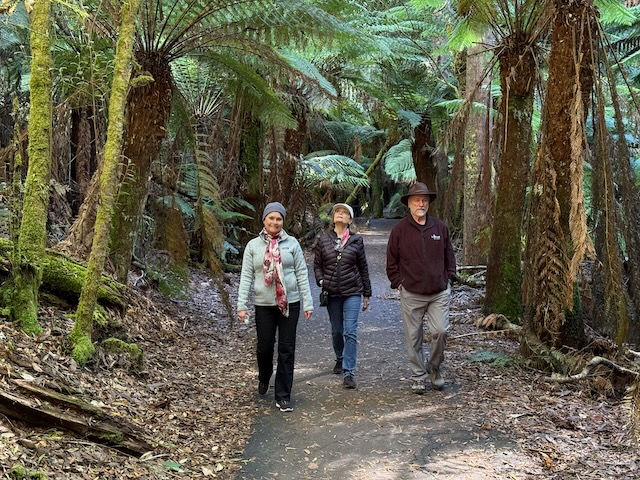
Delightful hike, under the shade of premordial-looking fern trees.

Pretty waterfalls.

More waterfalls.
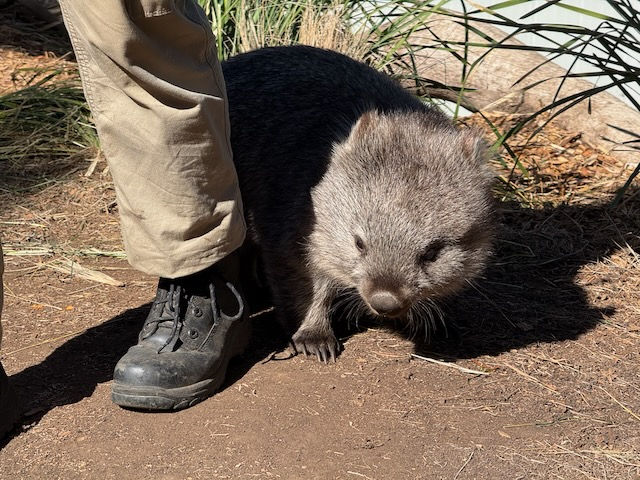
Off to the wildlife rescue and rehab center. Above left is our narrator. She says that if she showed us her legs we'd see they're black and blue, from where the playful wombat (above right) has bitten her playfully.

Kookabura, national bird of ?

Echidna. Doesn't have a pouch but grows extra folds of fat during the pregancy, to make her feel even more self-conscienious and to hold the eggs (and then joey). The young'un stays there until it starts to grow it's own quills, at which point mom says "ouch!"

A tasmanian devil. The jaw strength is four times that of a doberman.

The tasmanian devil has no hair on it's ears, the better to get rid of excess heat. When lit from the back the ears glow red, adding to it's devilish look.

Karen verifying that the young kangaroo fur really is quite silky.

A non-native. A resident 'for life'. If released it would 'over compete' for habitat.

So many kangaroos.

Tricia and one of the 'roos holding hands while it eats.

The lion lies down with the lamb. Or in this case, Don lying down with his friend, Joey.

Looking down on Hobart for the top of Mount Wellington (known as Kuryani to the original owners)

We stop for a refill of our water bottles at a local fresh water spring.
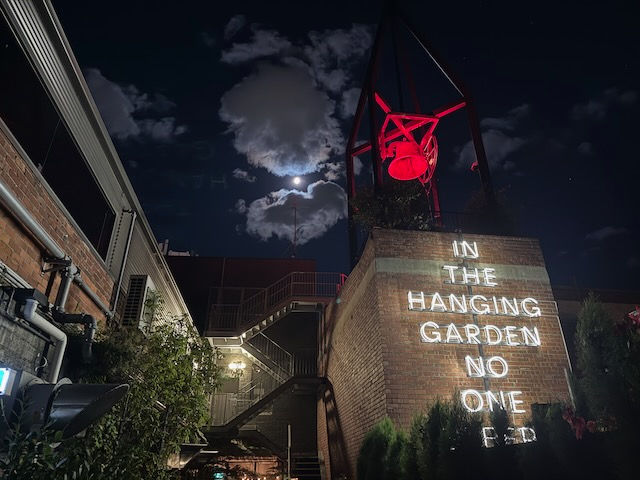
Dinner locale, the "In the Hanging Gardens" restaurant. Their motto is "No one sleeps", but that really only applies in the height of summer (around Christmas). Otherwise 9:45 is about it.


Comments